
|
Balance exercises for seniors are simple, low-impact movements that strengthen the legs, hips, and core to help the body stay steady. They matter because better balance is a key factor in falls prevention in older adults. The risk of falls increases with age, and practicing balance exercises regularly helps maintain confidence and mobility for everyday activities like walking, climbing stairs, and standing up safely. |
Have you noticed that lately it takes a little more concentration to step off a kerb, reach for something on a high shelf, or walk on uneven ground?
If this is happening, you may find you’re not as confident getting out and about as you used to be. Fortunately, your balance is something you can work on to improve at any age. Simple, regular balance exercises for seniors can help to strengthen the muscles that keep you steady, sharpen your coordination, and give you the confidence to keep doing the things you enjoy.
Disclaimer: This information is general in nature and does not replace medical advice. If you have concerns about your balance, or a medical condition that may affect your stability, please speak with your GP before starting a new exercise program.
Why balance exercises for seniors matter for everyday independence
Good balance is at the heart of everyday independence. It's what allows you to walk to the letterbox, get in and out of the car, tend the garden, or carry shopping without worry. When balance begins to decline, even familiar tasks can start to feel uncertain.
Falls are the leading cause of injury-related hospitalisations, according to the Australian Institute of Health and Welfare (AIHW). Reduced balance increases the risk of falls, which may impact mobility, confidence, and the risk of fractures.
- Improving coordination and stability for daily tasks
- Strengthening key muscle groups so you can be mobile for longer
- Supporting safer movement at home and outdoors, enabling a wider range of activities
- Building confidence for everyday activities, improving quality of life
- Falls prevention, helping to protect independence
What causes balance decline as we age?
If you are finding that your balance has declined over time, there are several factors that could be contributing to this, such as:
-
Loss of muscle strength, particularly in your legs and core
- Joint stiffness limiting your range of motion
- Changes in vision that are affecting your spatial awareness
- Slower reflexes reducing your ability to react quickly
- Inner ear or vestibular changes
- Medication side effects
These changes increase the risk of trips and falls, leading to reduced confidence moving around. The encouraging part is that some of these factors can be improved with regular, targeted exercise.
Related articles
Breathing exercises for seniors
Resistance band exercises for seniors
Fun activities for seniors in assisted living
Safety tips when doing balance exercises
Before starting any exercise routine, it’s important to stay safe. Go at your own pace and listen to your body. Some general guidelines are:
-
Use a sturdy chair, bench or wall for support
- Wear comfortable, non-slip footwear
- Start slowly and build up gradually
-
Stop if you feel dizzy, unsteady or in pain
-
Speak to your GP or physiotherapist if you have concerns
A safe and considered approach helps to ensure your balance exercises are more effective and more enjoyable.
Exercises for elderly to improve balance – where to start
If you’re new to exercise, begin with simple movements and focus on consistency rather than intensity.
- Aim for 10-15 minutes daily
-
Choose exercises that match your current ability
-
Use support where needed
-
Progress gradually over time
At home
There is also no need to go to a gym or purchase fancy equipment. Many balance exercises can be done at home with little to no equipment, so it’s easy to build them into your daily routine.
Exercise classes
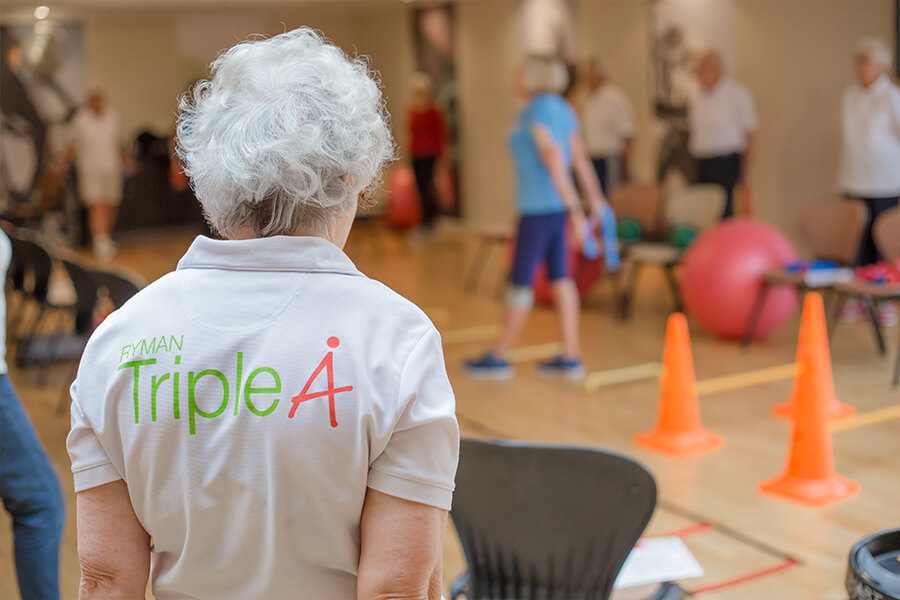
If you like to exercise with others and live in a Ryman village, balance exercises are incorporated into many of our complimentary Triple A (Ageless, Active, and Aware) classes. You can improve your strength and balance while socialising with your neighbours, then head to the cafe together for a treat afterwards.
Simple balance exercises for the elderly to try at home
These beginner-friendly balance exercises for seniors can help build strength and stability. They are a good place to start before you move on to dynamic balance exercises.
Single-leg stand (with support)
- Stand behind a chair and hold the back for support
- Lift one foot slightly off the ground
- Hold for 5–10 seconds, then switch sides
- Tip – keep your posture upright and steady
Sit-to-stand
- Sit in a sturdy chair
- Stand up without using your hands if possible
- Slowly sit back down
- Tip – use armrests if needed
Side leg raises
- Hold onto a chair
- Lift one leg slowly to the side
- Lower with control and repeat
- Tip – avoid leaning your body
Marching in place
- Stand tall, holding onto a chair or countertop if needed for support
- Lift one knee up, then lower, alternating legs like a slow march
- Continue for 30 seconds to 1 minute, or about 10–20 steps
- Tip – keep movements slow and controlled, don't rush
Standing toe or heel raises
- Stand behind a chair and hold the back for support
- For heel raises: raise up onto your toes, hold briefly, then lower back down
- For toe raises: lift your toes off the ground, hold, then lower
- Repeat 10–15 times
- Tip – move slowly and avoid locking your knees
You can also explore this guide to simple hip exercises for seniors to further support strength and stability.
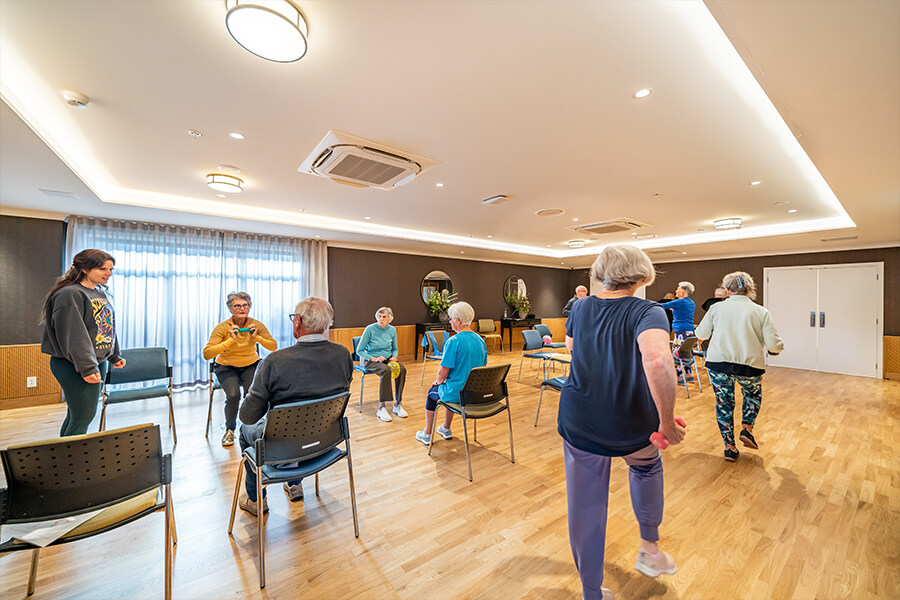
Dynamic balance exercises for elderly – building strength and coordination
Once you feel more confident, dynamic balance exercises can help improve how your body responds to everyday movement such as turning to answer someone, getting on and off a bus, and getting up from a chair.
- Reaction time
- Coordination
- Confidence during movement
They are especially useful for activities such as turning, reaching and navigating uneven surfaces.
General guidance if you’re doing these alone:
- Always have a stable surface within arm's reach, even if you don't plan to use it.
- Wear supportive, non-slip footwear – never socks alone.
- Keep a phone nearby in case you need to call for help.
- Stop immediately if you feel dizzy or lightheaded.
- Start with 2–3 sessions a week and only increase reps or difficulty once each exercise feels comfortable and controlled.
Heel-to-toe walk
-
Find a clear path at least 8–10 feet long, ideally alongside a wall or counter you could use for support if needed.
-
Stand tall, shoulders relaxed, eyes looking straight ahead (not down at your feet).
-
Place one foot directly in front of the other, heel touching the toes of the back foot.
-
Take slow, deliberate steps, arms out slightly for balance if that helps.
-
Walk 10–15 steps, pause, turn around carefully, and walk back.
-
Repeat for 2–3 passes.
If you feel unsteady: widen your stance slightly (a small gap between heel and toe rather than touching) and stay near your support surface until you feel steadier.
Step-ups
- Stand facing your step or stair, with a railing or wall within easy reach.
- Keep your fingers resting lightly on the railing or wall, not gripping or pulling.
- Step up fully with one foot onto the step.
- Bring your other foot up to meet it, standing tall at the top.
- Step back down with the first foot, then the second.
- Repeat 8–10 times leading with the same leg, then switch legs.
- Do 2 sets per leg, resting in between.
Safety check: make sure the step is dry, stable, and well-lit, and wear shoes with good grip – not socks or slippers.
Turning and reaching
- Stand with feet hip-width apart, near a stable chair, counter, or wall (close by, but not holding it).
- Place an object off to one side – a cup, book, or similar – at a comfortable reaching distance.
- Turn your torso and head toward the object, letting your feet pivot naturally rather than staying rigid.
- Reach out and touch or pick up the object, keeping your movements slow and your core gently engaged.
- Return to facing forward.
- Repeat on the other side.
- Aim for 8–10 reaches per side, 2 sets.
Tip: start with the object close and only move it farther out if reaching feels easy and controlled.
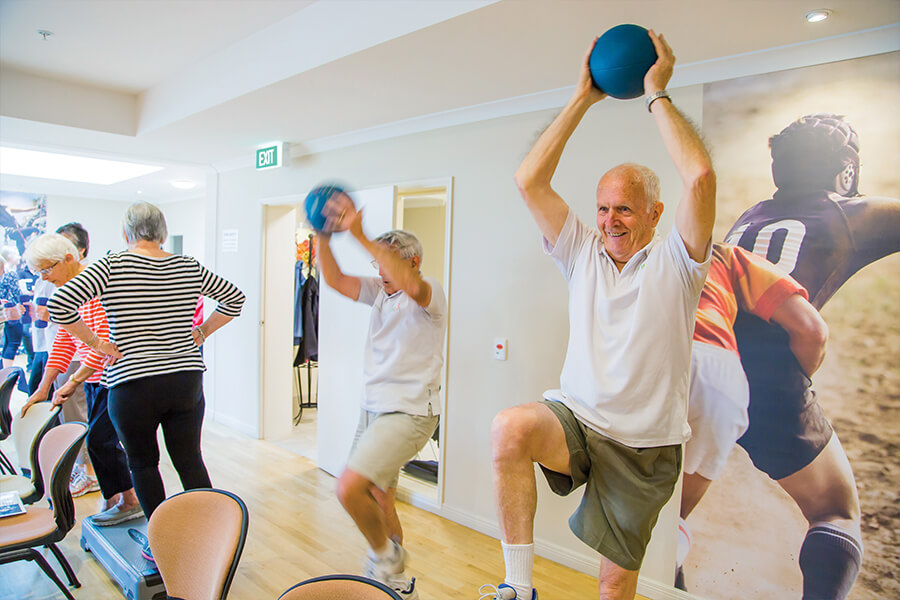
How Ryman supports safe exercise and wellbeing in retirement living
At Ryman, we understand that staying active is key to maintaining independence and wellbeing. We provide a lot of ways to do this, and residents pick and choose the options that they enjoy.
- Triple A group exercise sessions
- Activity programs designed specifically for older adults
- Access to village amenities such as gyms and swimming pools
- A supportive, social environment where you can meet like-minded people
Retired GP and Ryman resident George recommends that people move to a retirement village while they are still fit enough to make the most of the lifestyle on offer.
“I’ve seen so many people who hang onto their homes as long as they possibly can and then some tragedy occurs and they are shoved off to a nursing home where they don’t want to go,” he says.
Ryman’s approach focuses on safe, supportive movement – helping residents build strength, improve balance and stay active with confidence, all while doing things that they enjoy.
George says, “I’m enjoying the gym and swimming pool and I used to play a lot of billiards when I was a student instead of studying, so I’m enjoying doing that again too.”
Explore Ryman retirement villages near you to see for yourself how village life supports active, independent living.
Frequently asked questions about balance exercises for seniors
by Christine McCurdy | Sep 8, 2026
Breathing exercises for seniors
Hip exercises for seniors