

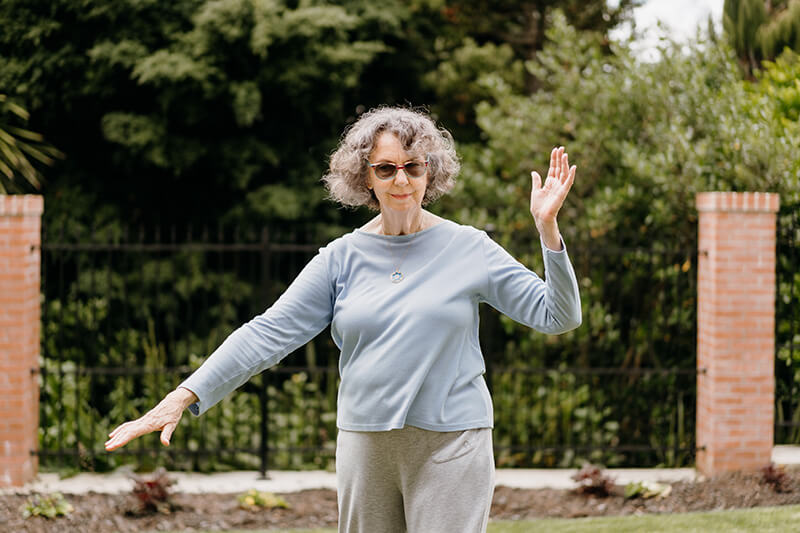
At its heart, tai chi is about linking the mind, body and spirit through slow, deliberate movement. It has been practised for many generations in Asia and increasingly around the globe as a way to improve physical health and reduce stress.
Watching from the outside, you might mistake it for a slow dance or a form of flowing yoga, but its origins are in Chinese martial arts. With a strong emphasis on balance, strength and posture, it's often recommended to anyone wanting to improve their general wellbeing.
Practising tai chi builds fluidity of movement alongside structured, controlled breathing. Consistency will bring the greatest rewards, but even a single session can leave you with a sense of calm that comes from focusing purely on your breath and your motion.
Learning the different forms
Individual moves are grouped into sequences known as forms. These range widely in length, from around two dozen movements in the shorter sequences, to well over a hundred moves in the longest traditional versions. So, if you're searching for a gentle path to harmony between your body and mind, there's a place to start regardless of your fitness level or physical ability.
As your practice develops, you'll gradually pick up more moves and start linking them into longer, more complex forms of your own.
One of the simplest things about this discipline is that there is no equipment required. This means you can practise tai chi virtually anywhere, even seated.
Sharpening your focus
Because the movements are slow and controlled, they require concentration, which is thought to help strengthen memory and balance over time. The steady rhythm of breath and motion is also linked to mental health benefits, with practitioners often describing a feeling of lightness that lifts mood and outlook.
Getting the technique right matters, so if you're new to it, look for a qualified instructor who can tailor your sessions to your ability and fitness level. Joining a class is also a great way to meet others who share your interest.
Beginning a tai chi practice
Five branches, one practice
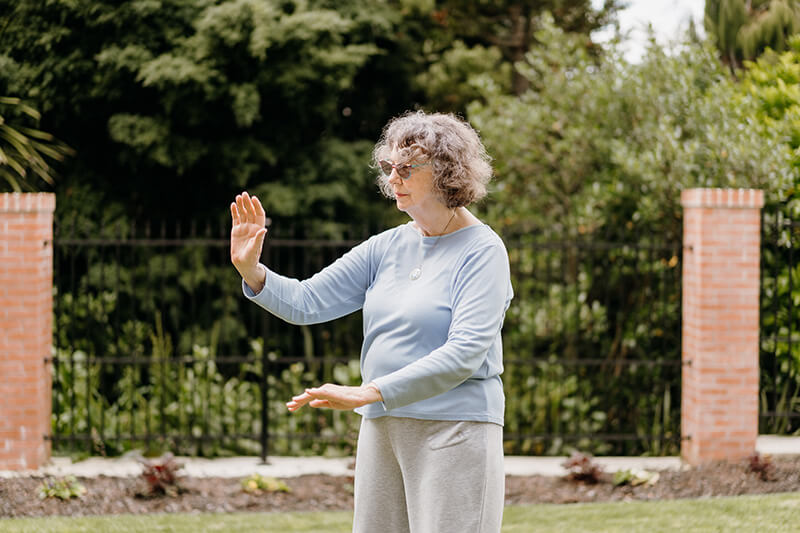
Tai chi has five major branches, each named after the Chinese family that developed it: Chen, Yang, Wu Hao, Wu and Sun. While they share common roots, each has its own character and focuses on different types of movement. Naturally, the practice has evolved over time, blending classical technique with more contemporary influences.
Most people picture tai chi as slow and gentle, and for the most part, that holds true. But not every branch sticks to this quiet, flowing style; Chen style, for instance, mixes slow movement with fast, explosive bursts, while other branches have a more graceful, dance-like quality.
Five tai chi-inspired moves to try
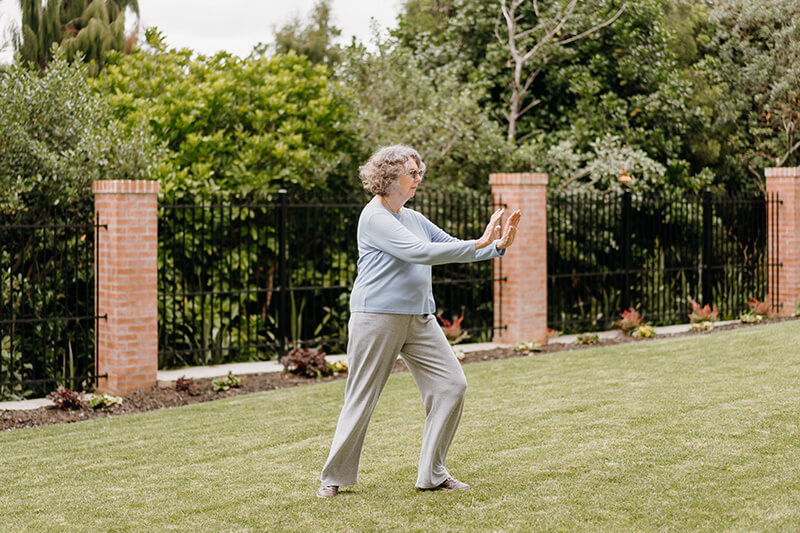
The five movements below are simplified, introductory exercises drawn from tai chi and qigong practice, to give a taste of the principles rather than a full traditional sequence. If you'd like to learn an authentic form, a qualified instructor is the best place to start.
Withdraw and push
-
Stand in a wide stance with your knees softly bent, and sweep both hands out to the left in a pushing motion, palms facing outward.
-
Breathe in as you slowly draw your arms up and back towards your body, as if tracing the curve of a large ball, leaning into your left leg to add power to the push.
-
Repeat this circular pattern three or four times while keeping your focus on your breath, then switch to the right side.
Holding ball
-
This move is all about breath and focus. Stand with feet slightly wider than shoulder-width, toes pointing forward.
-
Sweep your arms upward with palms facing the sky until your fingertips reach eye level, then turn your palms to face one another.
-
Hold this position for around 30 seconds, letting your breathing set the pace of your movement.
-
To finish, lower your palms gently and bring your feet back together.
You might also be interested in: Breathing exercises for seniors
Rising and sinking
-
This is a great move for building balance. Start in a neutral position, arms by your sides, feet together.
-
Step out with your left foot, take a full breath in through the nose, and let your arms rise in time with the step, palms down, moving up to eye level, then sweeping across the body to finish on the right.
-
The path your arms trace should resemble a soft-edged rectangle roughly as wide as your arm span. Concentrate on keeping your weight evenly balanced throughout.
Related articles: More information about balance exercises for seniors
Embrace the circle
-
This move is ideal for building strength. Lift your left foot into a side lunge while raising your arms outward and then straight overhead.
-
Sweep them back down and inward across your face, linking your thumbs together with fingers fanned out at chest height.
-
From a wide stance with feet forward, lower into a squat at roughly 90 degrees.
-
Breathe in through the nose and out through the mouth in a slow, controlled way, holding the position as long as you comfortably can before rising and releasing your hands.
Crane spreads its wings
-
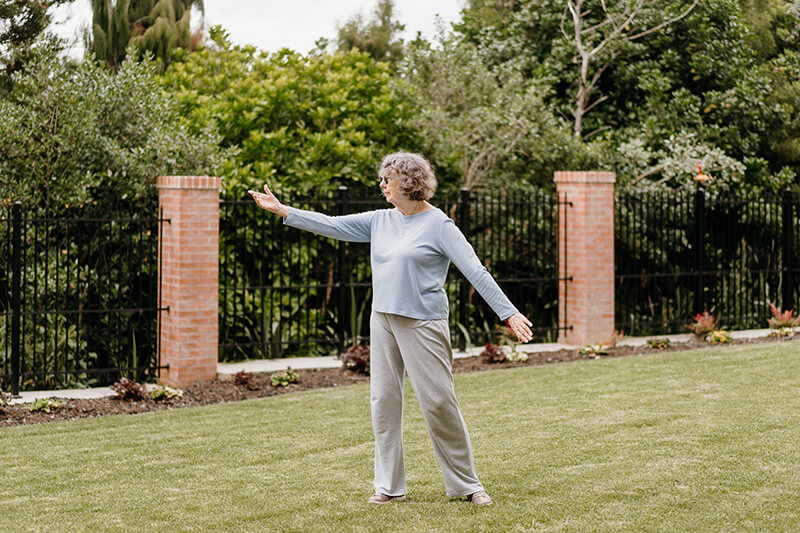
From a wide stance, extend your arms out to head height with palms facing down.
-
Sink gently into a shallow squat while moving your arms down and up, echoing the motion of a bird's wings.
-
Keep your wrists relaxed and repeat, breathing in as you rise and out as you lower.
Tai chi for mental and physical health
Mental health benefits
One of the things that makes this practice so beneficial is how it engages the mind and body at the same time. The combination of slow, purposeful movement and steady breathing creates a naturally meditative state, which many people find helpful for easing stress and anxiety and improving sleep quality. It's also widely thought to support cognitive function, sharpening memory and concentration.
Physical health benefits
The physical benefits of tai chi centre mainly on balance and strength. Better balance is particularly valuable for those at higher risk of falls, while people managing arthritis or recovering from injury often find it eases discomfort by gently improving flexibility and mobility. Because it engages every major muscle group, regular practice builds strength throughout the body, and holding poses for extended periods helps develop muscular endurance too.
A lifestyle of wellness at Ryman
As people get older, remaining well is a foundational part of enjoying life to the fullest, which is why we have developed initiatives that enhance wellbeing, such as the Triple A complimentary exercise program, which caters to all ability levels.
Many residents discover that they have become more active since moving into a Ryman village. Taking part in the program improves their strength, balance and mobility, helping to prevent falls and to maintain independence.
by Christine McCurdy | Sep 16, 2026
How care and connection made Bert Newton Village home for Effie

Urgent action needed to meet seniors' housing and health needs